Showing posts with label desert painting. Show all posts

Saturday, December 9, 2023

Painting thin lines the easy way

Close to the Earth, © 2023 PM Arnold
20x20", Oil on gallery canvas

I took the photo of this Rabbit Brush shrub in 2002 on a trip up Hwy 395 to Mammoth Mountain from Ventura County in November. There was fresh snow on the Sierras and the leaves had turned orange and rich red-browns on all the willows and brush in the dry washes that ran from the foothills down into the Owens Valley. I rediscovered it looking through my old photos this fall and decided it was time to try painting it. I had had some practice painting skinny twigs and thought I might be successful this time, but was still very surprised at how well it went.

I've never had much luck painting thin lines with small round brushes, and especially now that my hands shake more than they used to. But what I have found that works is a 3/8-to-1/2" bright brush, synthetic or fine hair, using the long edge and touching it as lightly to the canvas as I can. The paint has to be liquid enough to flow off the brush, and if I make a blob or the line is too thick I swoop in immediately with a clean brush to pick up the extra. The other attribute of a brush this size is that it will hold a fair bit of paint, and it's not too hard to get a nice long line before you run out of paint. Only new or un-frayed narrow-edged brushes will work, and I try to keep a newish one on hand just for this purpose. Once I cover an area with lines I'll usually let them dry before I paint on top them; once I get good ones down, I don't want to risk messing them up.

In the photo, the sand & dirt was covered with a layer of tiny gravel, but I decided that was more texture than the painting needed, and just shaded in the varied grays and tans without offering much detail. Painting the live and dead branches took the most time, as I was trying to capture their varied colors and "bundle" appearance.

Wednesday, February 8, 2017

A different canyon, a very different experience


I wanted to paint this canyon as soon as I saw it; it seemed like the archetype of a high desert canyon. I picked it for my second try at Zion and was hoping for another short and easy sketch, but by the time I had five hours on it and it still didn't look anything like I wanted it to, it obviously wasn't either.

I decided it must be a problem-solving session for painting rock formations, and that's something I want to learn to do, so I just kept working on it. The big question in my mind was, how much detail should I put in? I guessed the answer is, however much as pleases me. I had to try to find a balance between the endless textures in the photo and the minimum amount required to make not a quick sketch, but a painting. It lacked the strongly delineated shapes of the last sketch, so it seemed that I would have no choice but to work on the surface textures of the walls. I put in what seemed like a medium level of shapes, feeling like I should concentrate the detail around the canyon opening. After that I spent quite a while first figuring out the colors, and then contouring the shapes. I left two areas without any detail just to see how they would compare with the rest, and I decided that was not enough detail.

There was one area I just couldn't get to work with the other sections, and I stared at it for a day without getting any ideas. But the next morning I woke up knowing I was ready to gamble that something good would happen if I just kept working on it. So the first thing I did that day was cover the whole area that didn't work with a wash of dark red. Immediately it not only fixed the problem, it completed a larger pattern of blocks of color that I hadn't really noticed beneath all the textures. It occurred to me that the design of this painting, rather than being lines, was the shape of those color blocks.


A couple of the sketches I've done lately have had more interesting compostions that I had in mind when I started them, so I've spent some time studying them. I'm going to try and keep track of the ones that I like.

Friday, October 14, 2016

More inventing = More fun ( Plus, SALE Announcement Below!)

Dog Made Of Moonlight
The moon dog is finished! For quite a while I wasn't sure I could scale up my 8"x10" sketch to 18"x24" and have it be interesting at all—it was such a simple design that it looked rather empty, like a dinner plate with two croutons on it. I was ready to paint over it and start again on a smaller panel when I finally got an idea to break the background into horizontal strips and just apply the paint within the strips. Desert landforms frequently have a noticeable horizontal aspect to them, with their different-colored strata and contours. I used a 7/8" brush and worked quickly and roughly, sticking to my color triad of red-violet, blue-green, and yellow-orange—plus blue which didn't belong but I liked it anyway—and making the values a bit on the imaginary side. I stopped trying to make it look realistic, settling on making it attractive and interesting as my main goal.

I was initially surprised by how much the rough, blocky strokes evoked the feeling of rocky bluffs, and it was fun playing inside the lines—sort of like taking the rules and using them to cheat, exploiting a design element in an unrealistic way to emulate the natural features of desert cliffs and canyons. I wasn't sure how best to use the two main colors so I just kept interleaving them, varying the values to support the overall design. As with my other recent paintings, a lot of my inspiration came from Bob Burridge—"If you don't like the direction, turn left and and keep going."

Like my sun dog, this lady is a spirit, made purely of moonlight, with an ethereal, reflective quality; an observer and thinker, far-seeing and wise.

****ANNOUNCEMENT****ANNOUNCEMENT****ANNOUNCEMENT****
I'm painting so much now my studio is crammed full and I'm running out of room!!

20% OFF EVERYTHING IN MY ETSY STORE THROUGH OCT. 31!!!!

Friday, July 15, 2016

Painting Zion

The Landing

The Landing is my second attempt to paint scenes from my Zion National Park photos. This was the top corner of a bluff that was across a valley looking into the late afternoon sun. But once I zeroed in on this small part of that composition, I loved the shapes and lines, and the backlighting. Once I got to the finishing stages, I played with the highlight colors a bit to bring out the color in the shadows. I also played with the color in the shadows. Again, I tried to make the leap from how the photo looks to how the actual scene looked and felt. I kept thinking about the blue and orange harmonies I worked with on the music paintings and was looking for opportunities to use some of those.

This is one of the scenes I found where I could totally imagine my story eagle character Tlocan flying around.

Monday, July 6, 2015

Painting a desert morning


I haven't had all that much luck painting detailed landscapes before, especially the mixed textures of dirt and grass, but I was pretty happy with the way this one turned out. I did a lot more glazing than I've been doing lately, putting in every color I could see, and this time it seems to be working. I do feel like I got really lucky with the colors, but this is my third painting of this area so maybe my experience is accumulating.

I think another part of the reason is that I really took my time with this one, almost the whole of the 12 days of heat we've had. And before that I worked longer than that on a still life that I may never finish because I came to detest even the idea of continuing with it. Maybe next year.

I also think—and this is going to sound strange to some—part of it has to do with the additional fish oil I've been taking. After borrowing Grain Brain and reading how important sufficient levels of fats of all kinds, including both HDL and LDL cholesterol, are to the health of the brain, I added fish oil to the flaxseed oil I've been taking, and a couple days later I started seeing visual slideshows of colorful images as I was going to sleep. That only lasted a couple days, but I couldn't help wondering if some small part of my optical brain was working just a teeny bit better. Plus, the acupuncture I've been getting has made me quite a bit more relaxed when I'm working.

Isn't the whole point of being healthy that your body (including brain) feel and work better?

Anyway, it was a fun painting to do. Much more fun than the still life. Guess I need to go back and study that stuff more.

Monday, January 26, 2015

Painting isn't about reality

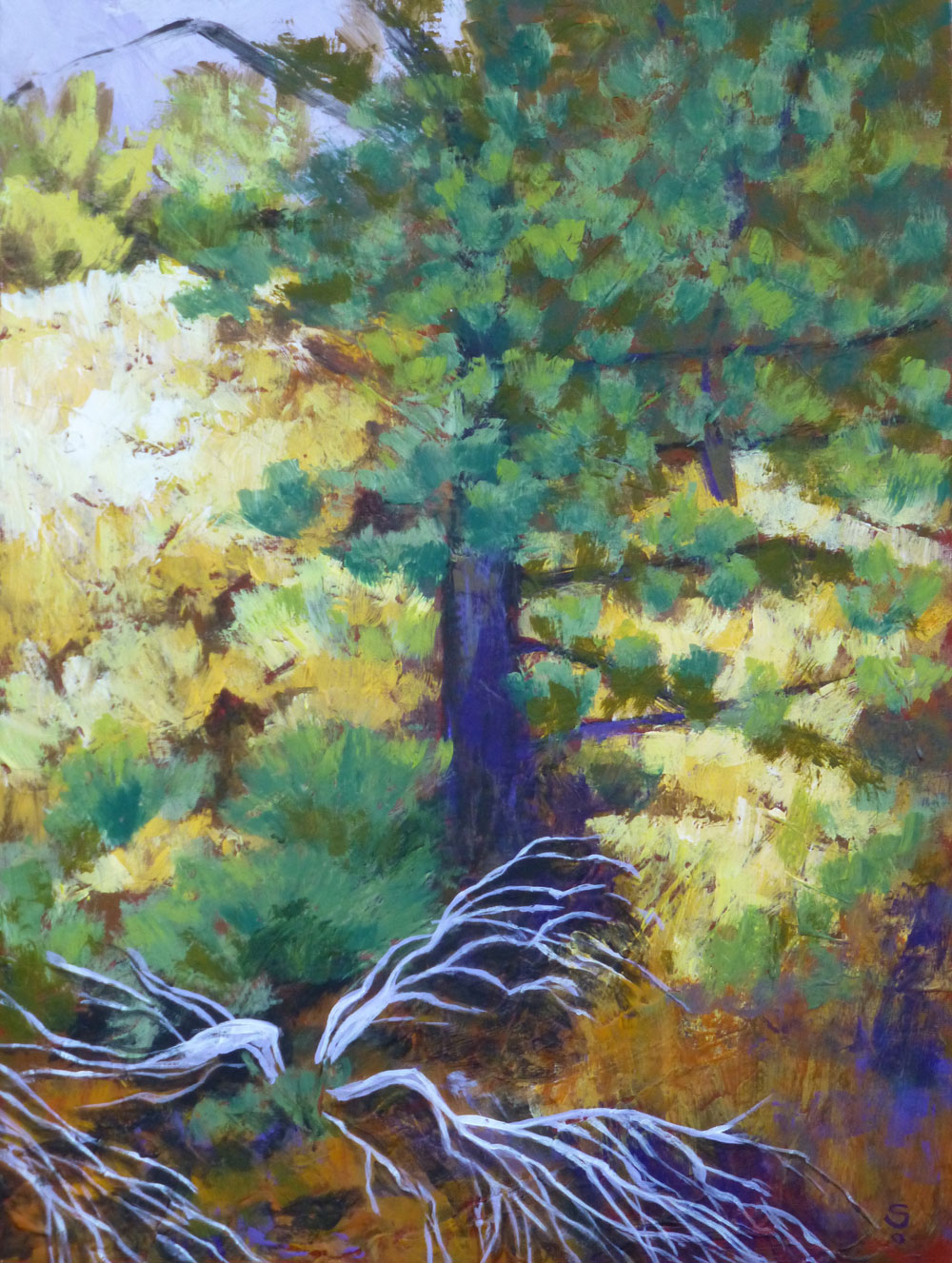
Juniper #2
12"x16" Acrylics on linen panel $90
You can purchase this painting HERE.

I watched my Joan Mitchell video again  yesterday, and wrote down this quote from Elizabeth Murray, a NY painter who knew Joan Mitchell: "Painting isn't about reality, it's about life. There's a level where you cannot explain it with words; it's visual." I was thinking about that a lot yesterday, and also what Joan said in the video: "I don't think when I paint." She was talking about people who ask her what she was thinking when she painted a particular work.

One of the things I really love about painting is except where you're consciously trying to make it look like something in particular, where you're doing a lot of comparing or measuring, the activity of painting is pretty much a thought-free zone. I'm pretty sure that images and thoughts/words come from separate areas of your brain. I use music or old movies to distract my verbal brain so it doesn't think about what I'm doing, so it isn't constantly worrying about whether or not what I'm doing is working. My eyes do the thinking, and that's not verbal thinking.

This juniper is from another photo I took last spring in north central Oregon, like the other juniper I did last summer. This one is purposely painted in a much looser style, except for the bleached "bones" of a shrub in the foreground.

I'm happy because this is the 4th painting I've finished this month! I think that's a record for me! I'm looking forward to my show at the new In Bocca Al Lupo Gallery this October, in its new location in downtown Oregon City. Speaking of which, here's the flyer for the first show there, opening weekend after next, the first weekend in February.


I bought my first plants of the year this morning—perky little primroses for my hanging pots out front. So my new little car does work for carrying plants, as long as they're not too big. That's a good thing. Happy almost-end-of-January!

Tuesday, June 24, 2014

Swinging the pendulum a little further


I felt so happy with the simplification in my last barn painting that I wanted to carry my boldness a little further on the next one. But, it was one of our gloomy days and I was a bit tired of painting gray skies and dark clouds, so I chose a photo recently taken in the high desert on the east side of the Cascades on a mostly sunny morning. I really wanted to stimulate myself to paint in warmer, more dramatic colors, so I started the painting with a drawing in black and burnt orange.


I was able to get the greens I wanted in the juniper needles, and the rough twisty bark of the juniper trunk was looking promising. I kept taking photos because I wanted to see later how it evolved. I kept laying in blocks of color, giving those colors the first priority, figuring I would shape them later, and hold off on detail till the end.


But on the second day, when I thought it should be close to done, the painting didn't have the same dynamics as the photograph did—it looked flat and uninteresting. When I got up on the third day, I spent some time looking closely for what I had missed in the composition. I noticed that the main difference was I had left the top part of the painting, especially the upper right quarter, too light. I added the dark area in the upper trunk, and darkened the foliage there as well, and with that the painting came back to life for me. It was only then that I realized how important that darkness was, in that part of the design, to the visual impact of the painting.

Juniper, Oregon High Desert
The whole time I was working on this painting I kept thinking of the line from "Best Exotic Marigold Hotel"—"Everything will be all right in the end; if everything is not all right, it is not yet the end." I was determined to do whatever I needed to do to make this painting live up to my high expectations of it.