Tuesday, October 26, 2010

Will work for FUN!

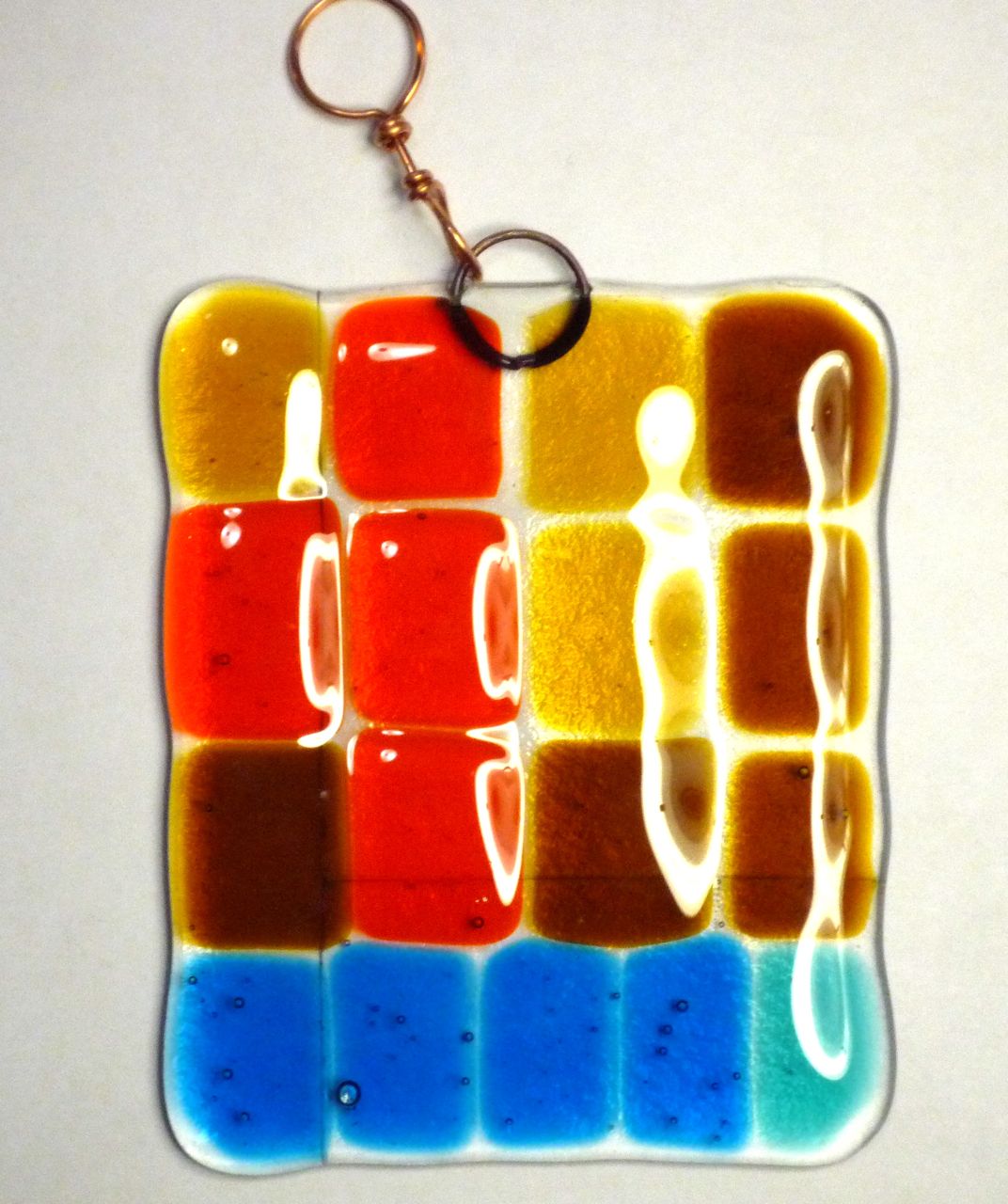
I went into the studio yesterday evening hungry for some colors, so I grabbed glass and cut up some blues, greens and browns, cleaned them and dumped them onto a sheet of paper. I looked at the pile and a light went off in my head. When I first started fusing I had had an idea of making an openwork piece, with gaps between the individual pieces. I'd made a couple tries at it but they hadn't looked good enough to fire. Now there was one sitting in front of me. With a little bit of rearranging, they turned into what I took out of my kiln this morning:

If you half-close your eyes, you can see my back yard in here!

I noticed with one of the other pieces I blogged about yesterday that it was the culmination of another idea that I had to iterate on several times before I got one that was recognizable as my original idea. Several other of the pieces that led up to it were interesting in themselves, just not what I had been aiming for. But they spun off other ideas to try to develop. That got me thinking about how often that had happened in my painting where I would have an idea of an image and work it up into a painting, only to have the result not really embody what I had imagined to begin with. But the paintings took so long that I would always figure that it was as close as I would be able to get, and rather than keep working on that idea I would go off in a new direction.

That reminded me very much of watching Pablo Picasso working in the excellent video I believe I have written about before, The Mystery Of Picasso. He reworked everything in the video as he painted it, constantly changing and revamping, wiping out and repainting a dozen times, or painting over, or throwing out and starting all over. I wonder if that was the issue with him, that he was trying to get closer to his starting idea. It might not be. Robert Burridge, if you've ever watched any of his videos (and if you have not, I recommend them highly) seems to pull stuff out of his hat as he goes, with or without an an actual beginning idea. He'll start with a thread of an idea, or hint of a thread of an idea.

I was taking some of these pieces down to Howden Gallery this morning, where they are now for sale, priced from $15 to $30, and started thinking about what I would answer if someone asked me, "Now that you're doing glass, are you going to keep painting?" I wasn't sure what the correct answer would be, but on the way back home I was thinking about the glass colors, and got an idea for another ink painting that I'll be doing soon. So, I guess Art feeds Art, and ideas come from everything you do! Or as Robert Burridge says, "No matter what the question is, the answer is always 'YES!'"

Monday, October 25, 2010

Passion takes a hand

A 1.5"x5" piece with both transparent and opal glass in garden colors—
blues, lots of greens, and a bit of pink and red.

One of my first rings, also a mix of transparent and opal glass.
A shot of warm color, like orange juice on a cold morning.

I've been having so much fun fusing. I just finished my 14th firing, a different style piece composed of overlapped small rectangles filling in a circular shape. It has to cool in the kiln for 6 more hours, so I won't see it till tomorrow morning—I'm not staying up till 2am! I've tried a couple different shapes and more new color combinations. Yesterday I spent a while making wire loops for them and monofilament hangers, and today, for the first time, I took the two pieces above outside and hung them on a garden pole in between rain showers. I love looking at them outside. The spots of bright color against the cloudy skies and the dark trees are really welcome additions to my garden. I want more out there, more pieces, and larger and more complex. I'm thinking of the single pieces as Garden Jewelry, for poor leafless trees that have to stand there naked all winter. But I have fences too, that can be decorated, and more garden poles, eaves, and low-hanging fir branches that can use some decoration too. The rings have the lovely habit of rotating slowly in the breeze, so the colors change a bit as the light hits from different angles.

Here are a few more pieces:

One of my friends said this one reminds her of that formica countertop
that came out in the 1950's that had little orange and turquoise boomerangs all over it.

A couple of the orange rectangles surprised me by turning dark red during the firing.

I thought that maybe from a distance, the clear might disappear and the blue pieces would look like they were floating in air.

The warmth of earth tones, the forest in summer.


When I was doing a firing a couple days ago, I had a really interesting moment. I was thinking about how playing with the glass was giving me an opportunity to reduce my work from painting to the two simplest and most important elements I had craved in my painting—color and shape. Creating good paintings requires so many more things, unless you go to color fields, which I came close to in my last ink painting. But with these small glass pieces, color and shape are all I'm working with. And as I thought that, it was as if a window opened in my side and I could see and feel a place in my core that didn't want to do anything but make colors and shapes, and it wanted to make piece after piece. No doubt, no thoughts, no emotion even, just this fierce drive—to work, to make, to do this one thing. I've felt the effects of that desire to create before, but I had never seen that core impulse in myself,  completely intense and unyielding, as an instinct might be.

So now I know what's making me do this. It's hard-wired into me.

Sunday, October 3, 2010

Painting with glass

Funny how every now and then you get up in the morning and do something different. One morning a couple of weeks ago I drove up to Portland and bought 15 pounds of scrap glass from a couple of professional glass artists, and ended up cranking up my little HotShot kiln that I hadn't plugged in since I moved into this house five years ago. It took me two days to find all my tools and books and firing logs, but eventually I got everything together and started playing with my scraps. Having them already cut into small random pieces made it really easy to get started, I didn't need a plan or pattern, I just had an idea of which colors to start with. I made a pile I liked:


Now I had an arrangement I liked, but it was too big to fire in my little kiln, so I cut the pieces down to this:


It was late night by that time so I went to sleep thinking of colors and shapes and different designs I could try, and right after breakfast the next morning I set up a chair and table in the garage so I could babysit my first firing in over five years. My brave little kiln fired right up and worked perfectly, and later that afternoon I was able to take out my piece and enjoy it:


I love glass! I love the colors, I love how it melts and flows together, I love the technical aspects and the need for focus and attention, and I really love how it adds light and beauty to a space. The transparency or translucency gives you another parameter to play with. It's also really fun to have something you can hold in your hands, and hang indoors or out.

I had so much fun I did four more firings in the next 6 days!

Here's another piece in the kiln, ready for firing:


And here's my latest piece, which I fired yesterday:


Having all these colors of glass, not to mention iridescence and dichroism and surface textures as well to play with is just like being a sugar junkie in a candy store. I think it might be addictive. One thing it's great for is playing with color in a free and fun way. But like the ink paintings, there's a need for precise control during the process and there's waiting involved, so it's no instant gratification thing. Patience is good, and it's something I find myself working on all the time.

Another great benefit to living in NW Oregon is that Portland is home to two premier manufacturers of glass for fusing, Uroboros and Bullseye, and probably hundreds of glass artists, many of whom are constantly pushing the boundaries of glassworking.

So I've got me another fascinating indoor hobby to work on through the winter. I hope to have a garden full of glass goodies by spring!

Sunday, July 18, 2010

Red Sky, Blue Planet


Mystery Of Water
Ink & Colored Pencil  22x30  $550

At last—a new painting! It feels good to finish one again. It's an ink painting, one I saw an image of in my mind before I started planning it. I let the idea settle for a couple of days, before I laid down the first layer of color on paper. After the first layer dried, I did a second layer to create the dark blue textures. It took several days for that layer to dry, before I could do the finishing work with colored pencils.

I had a new challenge in this one. I wanted to develop the foreground textures enough to be interesting, but I didn't want them to distract from the drama of the simplified background. It took me a few days to decide how much interest was enough. It's a personal choice, and at first I wasn't happy with having to make a choice at all, between doing what I've been doing lately—making the most of every possible detail—and directing all the strength to the main theme—the contrast between the landscape and the sky.

I used to joke about paintings that depend on having a spectrum of colors for their impact, and now I've made one that has little else. That's what comes of poking fun, I guess; the turkey comes home to roost.

What does it mean, The Mystery Of Water? Water connects us to every life form on the Earth. The storm in the sky is water, the lake and the river are water. Trees, grass, birds, bugs, humans—we are all made of water.

Friday, April 30, 2010

Time Spent Fishing

Afternoon Dream
Acrylic 30x15 $225

Fishing is a symbolic act. Artists are constantly fishing, first for ideas and then for the way to bring them to fruition. We bait our hooks with a need, a desire, to make a new painting or drawing or whatever. We throw that hook into the waters of consciousness, of memory and imagination, the great Cosmic Ocean. Sometimes we wait for days or weeks for a nibble, sometimes the fish is there waiting for us as if it knows our name. We reel in our catch and begin to see it for the first time. Then the magic—and the work—begin.

Depths Of Time 3: Honor The Earth

Depths Of Time 3: Honor The Earth
Ink & Colored Pencil 22x30 $550


The third painting in my Depths Of Time series is complete. This new one has a greater richness of color and texture than I've been able to achieve before. I'm not sure why it worked better, but I think it has to do with the particular sequence of colors in the inking and pencil layering. The inking is unpredictable as to density and exact pattern, and what I get each time is still a surprise. That doesn't keep me from trying new things each time to have more control over the result, but it's still a gamble. With the colored pencils, the sequence of layering and the time in between applying the layers also produces differing results. The translucence of the wax in the pencil pigments actually makes every layer visible as long as they're not too dark, so up close you see not just the color impression of the mix of hues, but at the same time, each separate hue.

The title actually comes from the theme of Annie Howden's next show starting in May at Howden Gallery, "Celebration Of Honor". My central theme of this series is to make visible the complexity of the invisible Earth beneath our feet, the Earth we seldom see and rarely notice. The roughly 4.5 billion years the Earth has existed are all there, written in that stone and dirt that our green world grows upon. It feels right to me to honor that time, and all the change that has taken place in that time.

Wednesday, March 10, 2010

Are Inktense pigments really permanent? Not so much...

I sure hate to have to eat my words, but after doing a couple more sketches with my new Derwent Inktense pencils, I'm having a little word snack, you could say. I was working on a 5x7 sunset painting with really deep blue-grey clouds and a dark foreground. I had put down a rich layer of blue and wanted to tint it fuschia, and was surprised to have lots of blue pigment come up as I tried to lightly wash over it. I hadn't noticed that happening with my first sketches on absorbent paper, and it wasn't obvious when I was building up the dark greens on the garden sketch in my last entry, perhaps because I was adding thick pigment over a thin wash. This time, however, I had hoped to do a pale thin wash over an already heavily pigmented area on the gessoed paper, and ka-BOOM! Up came the pigment.

The documentation all says the pigment has to be completely dissolved to become permanent, so I thought maybe I just hadn't dissolved it all, in my eagerness to make the color rich and dark. Today I decided it was important to find out just how dissolved they have to be, so I took a few wet tissues and wiped all the color I could off my dark, rich sunset. All I had left was a pale, water-color-ish ghost of what was there before. If you can envision a value scale, the darkest areas went from an 8 to about a 3. Sorry I didn't take a picture of it to show you. After the paper dried again to the touch I put on a medium wash of blue, taking the value back up to a 6 or 7. I used lots of water, and brushed the pigment around for a minute, making sure there were no visible particles of pencil left. I let that dry again for over an hour, till it was completely dry to the touch, and I took the same soft round brush I had used to make the wash and lightly rubbed it over a small area, using ample water. The color came up immediately, going back to almost as light as it was before this last wash.

Okay, so now I'm unhappy. I take my wet brush and go attacking all the other sketching I'd done—except the garden sketch—and find that the only color that doesn't come up is the amount that gets absorbed into the surface. On my watercolor paper, very little of the color comes up. On the gesso, almost all of it comes up.

Now why is that? What do you suppose I'm doing wrong? Is my water the wrong pH? Do I live in an area where the pigment won't ever really dissolve? Do I need to give the pigment another day to really dry?

So much for my dream of having a pencil behave like acrylic paint. Sigh. Of course whether this really bothers you is probably going to depend on how you paint. If you're used to working in watercolor, it's no big deal, and it does mean you'll be able to intentionally (as well as unintentionally) lift out pigment to lighten an area, and the less absorbent your surface is, the more you'll be able to lift. And if you want to put more color on an already dark area, just expect that the pigment will come up, and you'll be literally blending the new into the old.

But I wish I hadn't rushed to such a favorable judgment on them, and not believed what others wrote without testing it myself. Bad blogger! (Sorry.)

I think I'll go back to plain sized watercolor paper and keep playing with them. Also, I ordered 14 more colors that should be here soon!